Home Podcast Studio Acoustic Treatment | Perforated & Fabric Panel Solution
Space & Sound Challenge
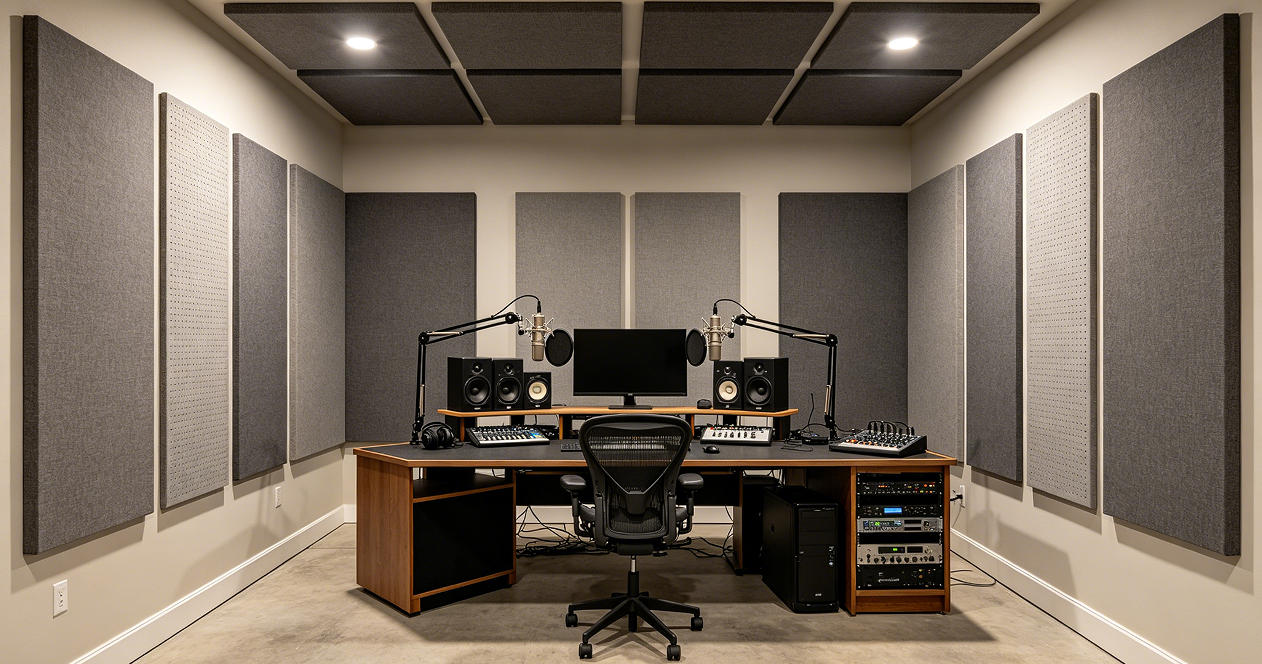
This dedicated home podcast studio sits in a converted garage of a suburban US single-family home, built for independent creators, interview recordings, audiobook narration and voice-over work. The original space had plain drywall and a sealed concrete floor, resulting in noticeable room echo and muddy vocal quality. Recordings picked up excessive room reverb, requiring heavy post-production editing to reach broadcast quality. The space also doubles as a casual video filming area, so a clean, professional visual finish was preferred over overtly technical foam paneling.
Tailored Acoustic Strategy
Perforated acoustic panels with mineral wool backing line the rear and side wall first-reflection zones, with an NRC rating of 0.80+. The perforated structure targets mid-low frequency resonance that causes hollow, boomy vocal sound, tuning standing waves common in small enclosed rooms to tighten vocal clarity without over-dampening natural tone. Remaining wall surfaces use high-density fiberglass-core fabric wrapped acoustic panels, NRC 0.85–1.0, in a neutral matte charcoal finish. The panels absorb mid-high frequency reflections and eliminate flutter echo, while the smooth woven fabric surface creates a clean, camera-friendly backdrop for video content. All materials are formaldehyde-free with ultra-low VOC emissions, safe for long hours of daily use in the enclosed space.
On-Site Results
Room reverb falls within the ideal range for voice recording and podcasting. Recorded vocals sound clean and natural, cutting post-production editing time by roughly 40%. The neutral matte walls also work as a versatile backdrop for video recordings and on-camera segments, making the small space multi-functional for all types of independent content creation.