Grooved Perforated Acoustic Panels | Manchester Community Arts Centre Acoustic Tuning
The Challenge
This 350㎡ community multi-use arts centre in Manchester hosts theatre workshops, choir rehearsals, public lectures and after-school kids’ activities. The original stone masonry walls and high vaulted ceiling create strong mid-low frequency standing waves and uneven sound distribution. Speech is muddy during talks and presentations, and music performances lack clarity and balance. The centre needed acoustic tuning that works for both spoken word and live music, while still respecting the historic character of the Grade II listed building interior.
Our Solution
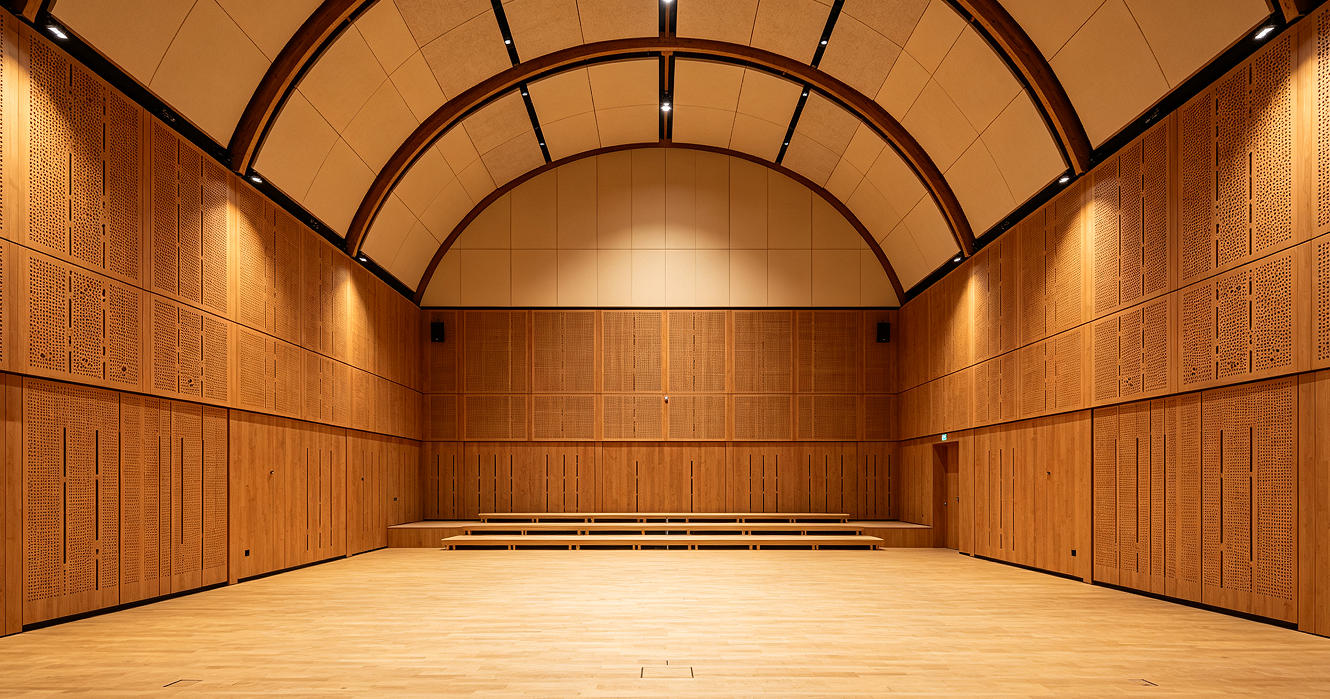
On side and rear walls we installed a grooved and perforated resonant acoustic panel system, paired with mineral wool infill and rear air cavities. We ran acoustic simulation on the hall’s volume and geometry, then precisely tuned the slot and perforation ratios to target the 250–1000Hz mid-low frequency standing waves that were causing most of the problem. The whole system hits NRC 0.90, delivering balanced full-band sound absorption that works for both speech and live music. On the ceiling we used high-density fiberglass acoustic tiles (NRC 0.90–0.95) to control overhead reflections and even out sound field coverage across the whole room.
All panels meet EN 13501 Class A fire safety for UK public assembly venues. We used a warm wood-effect wall finish that complements the historic stone interior, no modern industrial look.
The Results
Speech intelligibility improved by an estimated 45% across all seating areas, and music and theatre performances now have clearer layering and tighter bass response. The centre can reliably host both spoken events and live performances without extra temporary acoustic gear. Community group booking volume is up 30%, and the venue now qualifies for higher-tier regional arts funding.