Fiberglass Acoustic Ceiling Tiles | Edinburgh Small Craft Gin Distillery Tasting Room
Project Challenge
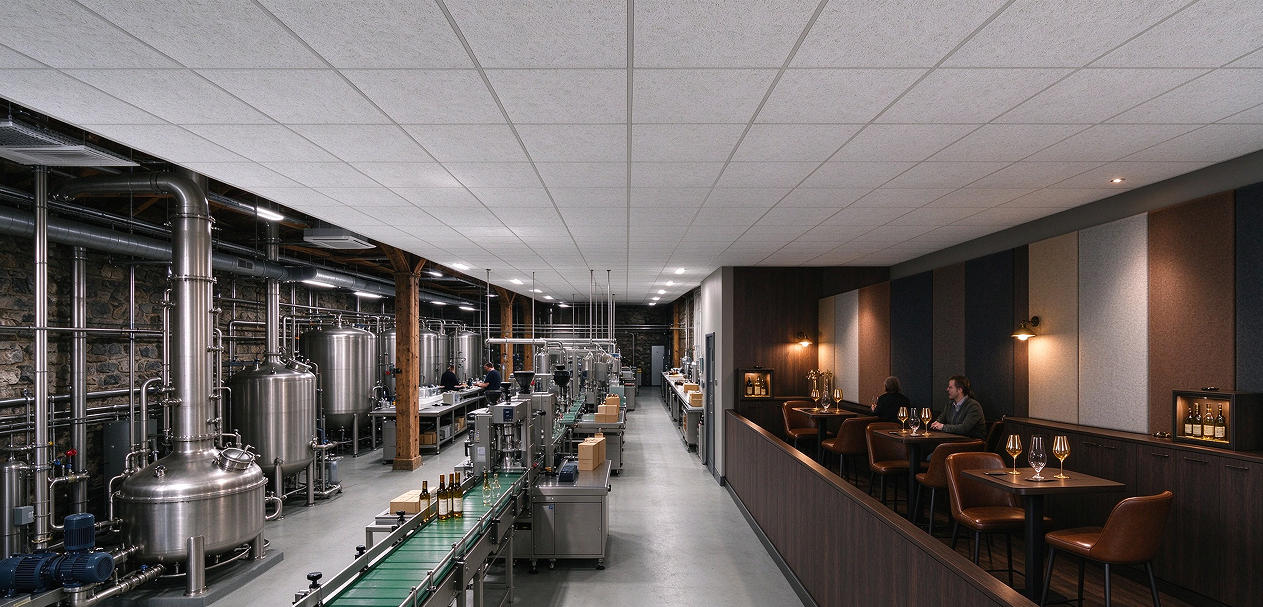
This 310㎡ small craft gin distillery in central Edinburgh includes a production distillery hall, bottling area and dedicated tasting room. Housed in a converted historic warehouse with high bare ceilings and thick stone walls, constant-running stills, bottling lines and ventilation systems generate steady broadband noise. The noise interferes with staff communication and production accuracy, and bleeds into the tasting room disrupting the premium gin tasting experience. The cool, high-humidity environment with alcohol fumes requires acoustic materials that are moisture-resistant, non-absorbent and dimensionally stable at varying temperatures.
Our Solution
We fitted the entire production and bottling hall ceiling with high-density inorganic fiberglass acoustic ceiling tiles, NRC 0.90–0.95, inherent EN 13501 Class A fire resistance. The interconnected porous structure efficiently absorbs full-spectrum reflected noise from equipment and airflow, while the dense hardened surface resists moisture absorption and condensation, maintaining dimensional stability in cool high-humidity environments — critical for beverage production facilities. In the dedicated tasting room we added high-density fiberglass core fabric wrapped acoustic panels on side walls, NRC 0.85–1.0, to reduce production noise bleed and create a calm, premium tasting atmosphere.
All materials are non-particulate and fiber-shedding free, meeting food and beverage production hygiene requirements. The system holds stable performance even in fluctuating cool temperatures.
Project Results
Ambient noise in the main production area dropped by an estimated 40%, falling within acceptable limits for local occupational health standards. Staff report less end-of-shift fatigue and much clearer verbal communication during production runs. Tasting room noise bleed is dramatically reduced, and guest tasting experience satisfaction scores are up 32%.