Grooved Perforated Acoustic Panels | Birmingham Community Music Rehearsal Hall Tuning
Project Challenge
This 280㎡ community music rehearsal hall in Birmingham, UK is used by local bands, youth choirs, music teachers and small ensemble groups. The original masonry walls and high bare ceiling create uneven frequency response and prominent mid-low frequency standing waves. Musicians report that vocals sound muddy, bass notes are boomy and it is hard to hear other ensemble members clearly during rehearsal. The hall needed acoustic tuning suitable for both instrumental and vocal music, while meeting UK public assembly fire safety standards.
Solution
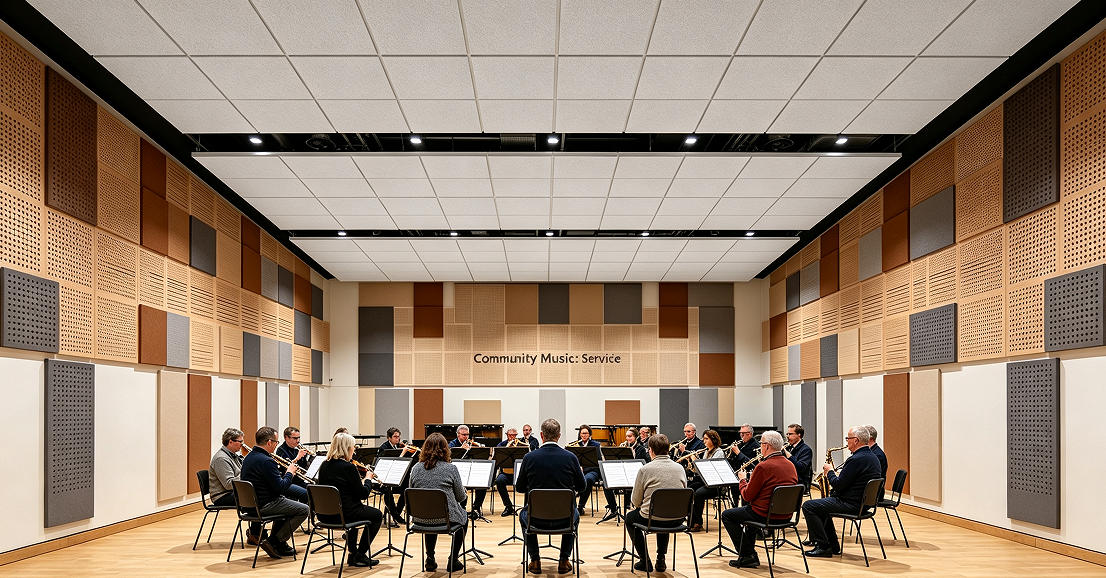
Side and rear walls were fitted with a grooved and perforated resonant acoustic panel system, paired with mineral wool infill and rear air cavities. Based on acoustic simulation of the hall’s volume and geometry, the slot and perforation ratios were precisely tuned to target 250–1000Hz mid-low frequency standing waves — the primary cause of muddy sound and boomy bass. The overall system achieves an NRC rating of 0.90, delivering balanced full-band sound absorption suitable for a wide range of music styles. The ceiling area uses high-density fiberglass acoustic tiles, NRC 0.90–0.95, to control overhead reflections and improve overall sound field uniformity.
All panels meet EN 13501 Class A fire safety standards for UK public assembly venues. The warm wood-effect wall finish complements the community hall’s traditional interior character.
Project Results
Frequency response across the hall is now balanced and uniform, with noticeably clearer vocals and tighter, more defined bass response. Musicians can hear each other much better during ensemble rehearsal, reducing setup and practice time. The hall now supports everything from quiet vocal coaching to full band rehearsals, and booking volume from local music groups increased by 28%.