Fiberglass Acoustic Ceiling Tiles | Toronto Electronics R&D Lab Noise Control
Project Challenge
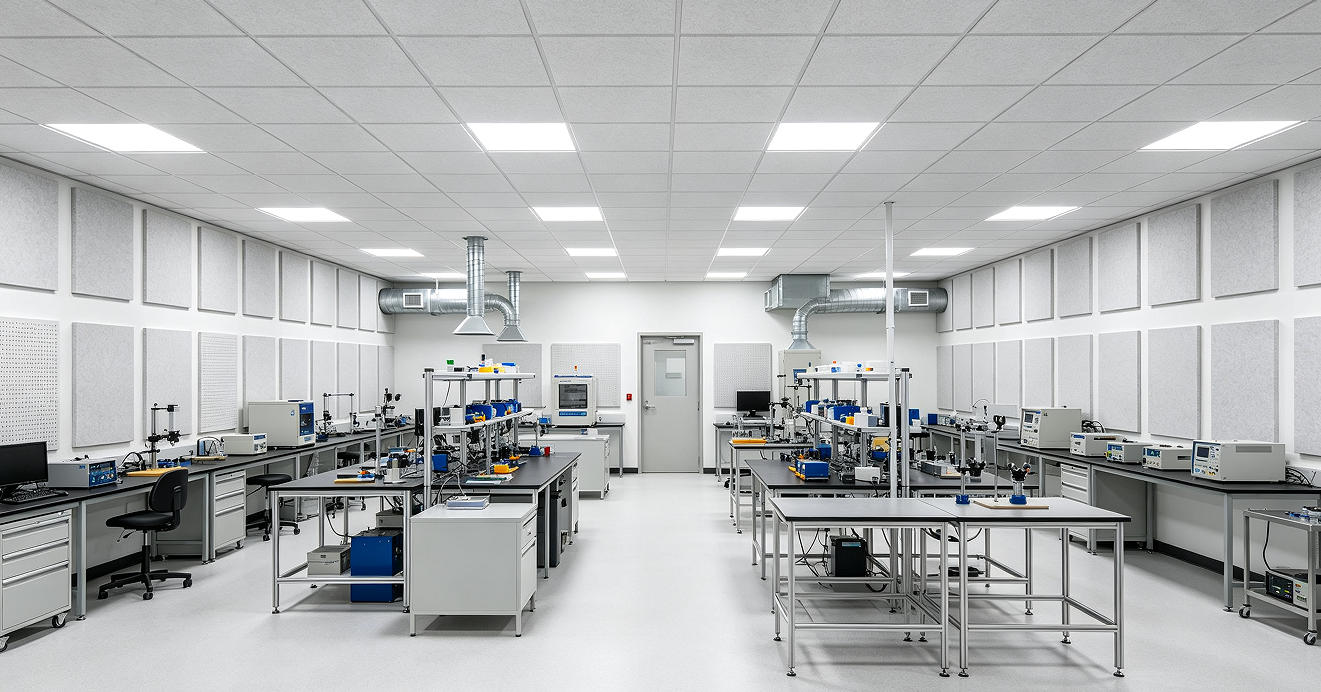
This 240㎡ small electronics R&D laboratory in the Greater Toronto Area houses precision testing stations, prototype assembly benches and a small equipment room. Testing instruments, ventilation systems and soldering stations generate continuous broadband noise, which interferes with sensitive measurement accuracy and creates long-term noise exposure for lab engineers. The facility maintains strict dust control and cleanability standards, so acoustic materials must be non-shedding, wipeable and compliant with laboratory hygiene requirements.
Solution
The full lab ceiling was fitted with high-density inorganic fiberglass acoustic ceiling tiles, with an NRC rating of 0.90–0.95 and inherent ASTM E84 Class A fire resistance. The interconnected porous structure efficiently absorbs full-spectrum reflected noise from equipment and airflow, while the dense hardened surface resists dust accumulation and supports regular wipe-down cleaning — critical for controlled lab environments. Partial perforated acoustic panels with mineral wool backing were added around the equipment room perimeter to assist with mid-low frequency equipment noise control.
All materials are non-particulate and fiber-shedding free, meeting laboratory dust control requirements. The system maintains stable acoustic performance in temperature-controlled indoor environments.
Project Results
Ambient noise in the main testing area dropped by an estimated 41%, falling within acceptable limits for precision instrument operation and reducing acoustic interference to measurement accuracy. Engineers reported less end-of-shift fatigue and clearer verbal communication during collaborative work. Measurement repeatability also showed measurable improvement following the upgrade.